Book Appointment Now


Vulvovaginal Health for Women Who Have Sex With Women
Vulvovaginal health for women who have sex with women: pH balance, BV prevention, STI risks, and evidence-based screening guidance explained clearly.
Vaginal symptoms that come and go, a pH that never quite feels stable, questions about what’s normal after sex with a female partner. These are real concerns that deserve real answers, not vague reassurances or advice written for a different audience. Vulvovaginal health for women who have sex with women (WSW) has its own biology, its own risk patterns, and its own gaps in mainstream clinical guidance.
The vaginal environment is a dynamic system. Hormonal shifts, sexual activity, hygiene products, and even stress can all alter the balance of bacteria that keep it healthy. When that balance tips, the result is often bacterial vaginosis (BV), yeast overgrowth, or increased vulnerability to certain infections. Understanding what drives these changes is the first step toward managing them with confidence.
At Lesbian STD, the focus has always been evidence-based sexual health education written specifically for women, including those whose healthcare has been shaped by assumptions that don’t fit their lives. If you’ve felt dismissed at a provider’s office or struggled to find information relevant to WSW sexual health, you’re not alone. For a deeper look at the STDs and vaginal infections that affect women, including transmission routes specific to WSW, that resource is worth bookmarking alongside this post.
What Is Vaginal pH and Why Does It Matter?
The vagina maintains a naturally acidic pH, typically between 3.8 and 4.5. This acidity is driven primarily by Lactobacillus bacteria, which produce lactic acid and hydrogen peroxide. Together, they create an environment that suppresses harmful microorganisms. When pH rises above 4.5, that protection weakens.
According to research published in the Journal of Infectious Diseases, women who have sex with women have significantly higher rates of bacterial vaginosis than women who have only male partners, a pattern researchers link partly to the exchange of vaginal fluid between partners. This makes pH awareness especially relevant for WSW, and it explains why the same woman can experience recurring BV even when her own habits haven’t changed.

What Health Risks Can There Be If Two Women Are Having Sex?
STI transmission between women is real, though it varies by infection type. Bacterial vaginosis, HPV, herpes, trichomoniasis, and syphilis can all be transmitted through skin-to-skin contact, oral sex, and shared sex toys. HIV transmission between women is low but documented. The critical problem is that most of these risks are routinely underestimated, by providers and patients alike.
WSW are not immune to STIs, but they are consistently under-screened because clinicians mistakenly assume low risk based on partner gender alone. Research from the University of Washington has documented that many WSW have had male partners at some point and may carry infections from those relationships. Meanwhile, woman-to-woman transmission of BV is well-established in the literature. Treating only one partner while leaving the other unexamined creates a cycle of reinfection that’s frustrating and entirely preventable.
- Bacterial vaginosis, strongly associated with new and multiple female partners
- HPV, transmitted through genital skin contact; Pap smears remain essential regardless of partner gender
- Herpes simplex virus (HSV-1 and HSV-2), transmitted through oral, genital, and skin contact
- Trichomoniasis, transmissible via shared sex toys and direct genital contact
- Syphilis, with rates rising in WSW communities in recent years
- Gonorrhea and chlamydia, possible through oral sex and shared, uncleaned toys
- HIV, rare but documented in WSW; PrEP eligibility should be discussed with a provider
If you haven’t had a recent screening or you’re unsure which tests apply to your situation, understanding sexual health screening for women explains what to ask for, and how often to ask for it.
What Throws Off a Woman’s pH Balance?
Many everyday factors push vaginal pH out of its healthy range. For WSW, vaginal fluid exchange during sex is a primary driver, especially if a partner currently has BV. A partner’s altered microbiome can directly disrupt yours in ways that no amount of personal hygiene will prevent on its own.
The most common disruptors:
- Douching, which strips healthy bacteria and is strongly discouraged by the CDC
- Scented soaps, washes, or sprays used around or inside the vulva
- Antibiotic use, which reduces Lactobacillus populations alongside harmful bacteria
- Menstrual blood, which is alkaline and temporarily raises pH
- Vaginal fluid from a partner with BV or a disrupted microbiome
- Hormonal fluctuations during the menstrual cycle, perimenopause, or pregnancy
“The vaginal microbiome is a delicate ecosystem. Disruptions to the Lactobacillus-dominant environment are consistently linked to increased susceptibility to bacterial vaginosis and other infections.”
— National Institutes of Health, StatPearls: Bacterial Vaginosis
Bleeding after sex, pelvic pain, or a sudden change in discharge can all be signs that something has shifted. These symptoms shouldn’t be normalized. A provider can run a simple pH test or wet mount to give you clarity fast, and that clarity matters for choosing the right treatment rather than guessing.
How to Balance pH After Sex
After sexual activity that introduces alkaline fluids or disrupts bacterial balance, some practical steps support recovery. None are complicated. Most take under five minutes.
- Urinate after sex to flush bacteria from the urethra. UTI symptoms in women, including burning, frequency, and pelvic pressure, develop quickly when bacteria travel upward and this habit significantly lowers that risk.
- Rinse the vulva (not the vaginal canal) with warm water only. No soap inside.
- Allow the vagina to return to its natural state on its own. It’s self-cleaning.
- Consider a probiotic containing Lactobacillus rhamnosus or reuteri if you’re prone to BV or yeast infections after sex. Evidence is growing, though not yet definitive.
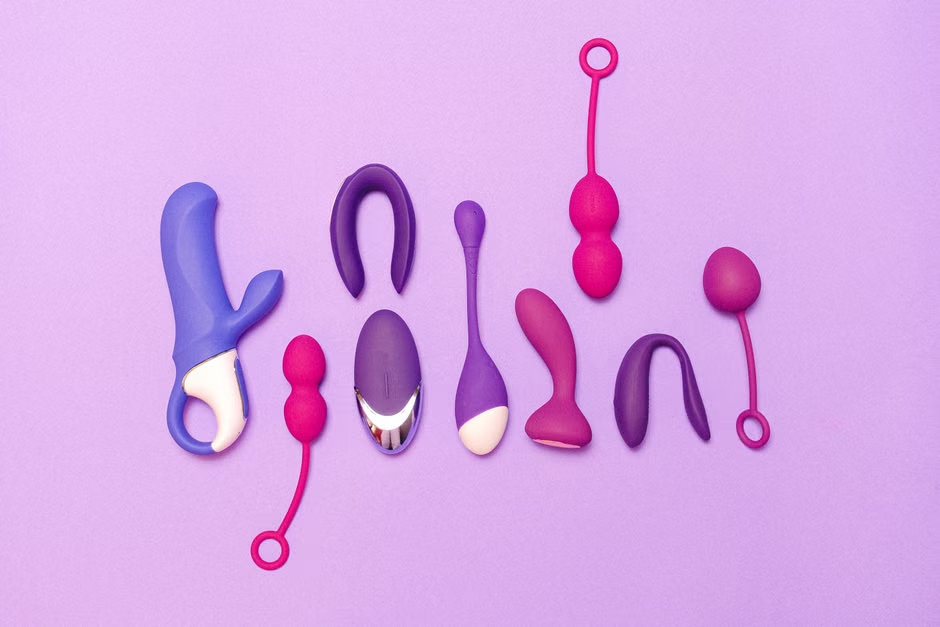
- Clean sex toys thoroughly between uses and before sharing. Unclean shared toys are a direct BV and STI transmission vector.
- If pH disruption is a recurring pattern, ask your provider about simultaneous partner treatment. Treating only one person rarely resolves the cycle long-term.
Pro tip: Barrier methods, dental dams for oral sex and condoms on shared toys, reduce microbiome disruption between partners significantly. It’s one of the most effective steps WSW can take for vaginal health, not just for STI prevention.
What Are the Side Effects of Daily Sex in Females?
Frequent sexual activity isn’t inherently harmful, but it does place repeated mechanical and biological demands on vaginal tissue. For most women, this isn’t a problem. For those already dealing with microbiome imbalance, it can perpetuate a cycle of irritation or infection that feels impossible to break.
Potential effects of high-frequency sexual activity include vaginal friction and minor tissue irritation, recurrent BV triggered by ongoing partner microbiome exchange, increased urinary tract infection risk when post-sex hygiene is inconsistent, and temporary changes in lubrication or sensitivity. None of these are reasons to avoid sex. They’re reasons to pay attention to your body’s signals and respond early when something feels off, rather than pushing through discomfort and hoping it resolves.
“Recurrent bacterial vaginosis is a common, frustrating problem for many women. Sexual activity with female partners is consistently identified as a significant risk factor in the epidemiological literature.”
— Centers for Disease Control and Prevention, Bacterial Vaginosis
Jenna Hardy, who develops the clinical education content on this site, frames it clearly: the goal isn’t to modify sexual behavior out of fear. It’s to give women the information they need to make decisions that serve their health. That distinction matters. Fear-based guidance doesn’t change behavior in lasting ways. Evidence-based awareness does.
When Symptoms Signal Something That Needs Attention
Not every vaginal change is BV, and not every BV episode is straightforward. Some symptoms call for prompt clinical evaluation rather than a wait-and-see approach.
- Discharge that is gray, yellow-green, or has a strong fishy odor
- Bleeding after sex not explained by your menstrual cycle
- Persistent itching or burning that doesn’t resolve within a few days
- Pelvic pain during or after sex
- Sores, ulcers, or unusual skin changes on the vulva or around the vaginal opening
These symptoms can overlap across conditions, from yeast infections and BV to herpes and early cervical changes. A clinical evaluation, not a self-diagnosis based on a quick search, is the right call. Providers who understand WSW sexual health will run the right tests and get you accurate answers without the guesswork.
Vulvovaginal health for women who have sex with women isn’t a niche topic. It’s foundational reproductive health that most mainstream resources underserve. Start with accurate screening, keep barriers and toy hygiene part of your regular routine, and respond early when your body signals that something has shifted. That combination, knowledge plus consistent action, is what keeps you ahead of the conditions that go undetected when women fall through the gaps of clinical guidance not written with them in mind. The resources at Lesbian STD’s STDs and vaginal infections section go deeper into specific conditions, transmission routes, and what to expect from treatment.